DeFi was built to remove intermediaries, but regulation did not disappear with them. As decentralized finance grows, teams face a real problem. Regulators want better KYC and AML controls in DeFi. Users, however, want open access and privacy. Many projects feel stuck between compliance pressure and decentralization ideals. Ignoring compliance raises regulatory risks. However, copying traditional KYC models harms user experience and disrupts protocol design. This tension defines the next stage of DeFi. The challenge isn't whether to have compliance. It’s about how compliance frameworks can grow while keeping decentralization intact.
Why DeFi KYC and DeFi AML Matter More Than Ever
Decentralized finance has moved far beyond experimentation. Lending, trading, derivatives, and payments now operate at scale through smart contracts. With this growth, regulatory attention has intensified.
Regulators are no longer focused only on centralized exchanges. They now look at how DeFi protocols, front ends, liquidity providers, and infrastructure work with illicit funds. As a result, DeFi AML expectations are rising across jurisdictions.
The core concern is visibility. Regulators aim to grasp how value moves in decentralized systems. They want to know if these flows link to scams, hacks, sanctions, or money laundering. DeFi KYC and DeFi AML are key for regulators to evaluate risk in blockchain systems.
In recent enforcement actions, regulators often did not target protocols directly. Instead, they focused on interfaces, governance contributors, or service providers connected to high-risk fund flows. This shows that even decentralized systems are not outside regulatory reach. Risk does not disappear simply because a protocol is permissionless.
For DeFi teams, this creates a new reality. Compliance decisions affect protocol growth, partner access, and long-term survival. DeFi KYC and DeFi AML are no longer theoretical discussions. They are operational requirements.
What DeFi KYC Means in a Permissionless System
Traditional finance (TradFi) uses a "gatekeeper" model. You need to prove your identity by uploading a passport or ID before opening an account. This model assumes that safety comes from knowing who the person is.
DeFi is based on permissionless access. This means anyone with a wallet can use smart contracts without needing approval. Applying legacy, identity-based KYC to this architecture creates a fundamental conflict. It puts centralized checkpoints on decentralized protocols. This can leave out unbanked users and create privacy risks.
So, how do we bridge this gap?
The industry is shifting from "Know Your Customer" (KYC) to "Know Your Transaction" (KYT) and Wallet-Based Due Diligence. Instead of demanding personal data upfront, this approach analyzes on-chain behavior. It asks:
-
Has this wallet interacted with known hack proceeds?
-
Is the liquidity coming from a sanctioned entity (like Tornado Cash)?
-
Does the transaction history show patterns of money laundering?
DeFi can keep compliance standards by focusing on the asset's journey instead of the user's background. This way, it doesn't lose the key principles of decentralization.
The Risks of Ignoring DeFi AML
Protocols with no DeFi AML controls risk becoming preferred channels for illicit activity. Over time, this creates serious consequences.
These risks often appear in several ways:
1. Infrastructure restrictions
Stablecoin issuers, bridges, and oracles may limit interaction with high-risk protocols.
2. Front-end pressure
Websites, APIs, and interfaces are targets for regulation. They are easy access points for control.
3. Partner withdrawal
Banking partners, payment providers, and custodians may refuse to work with non-compliant projects.
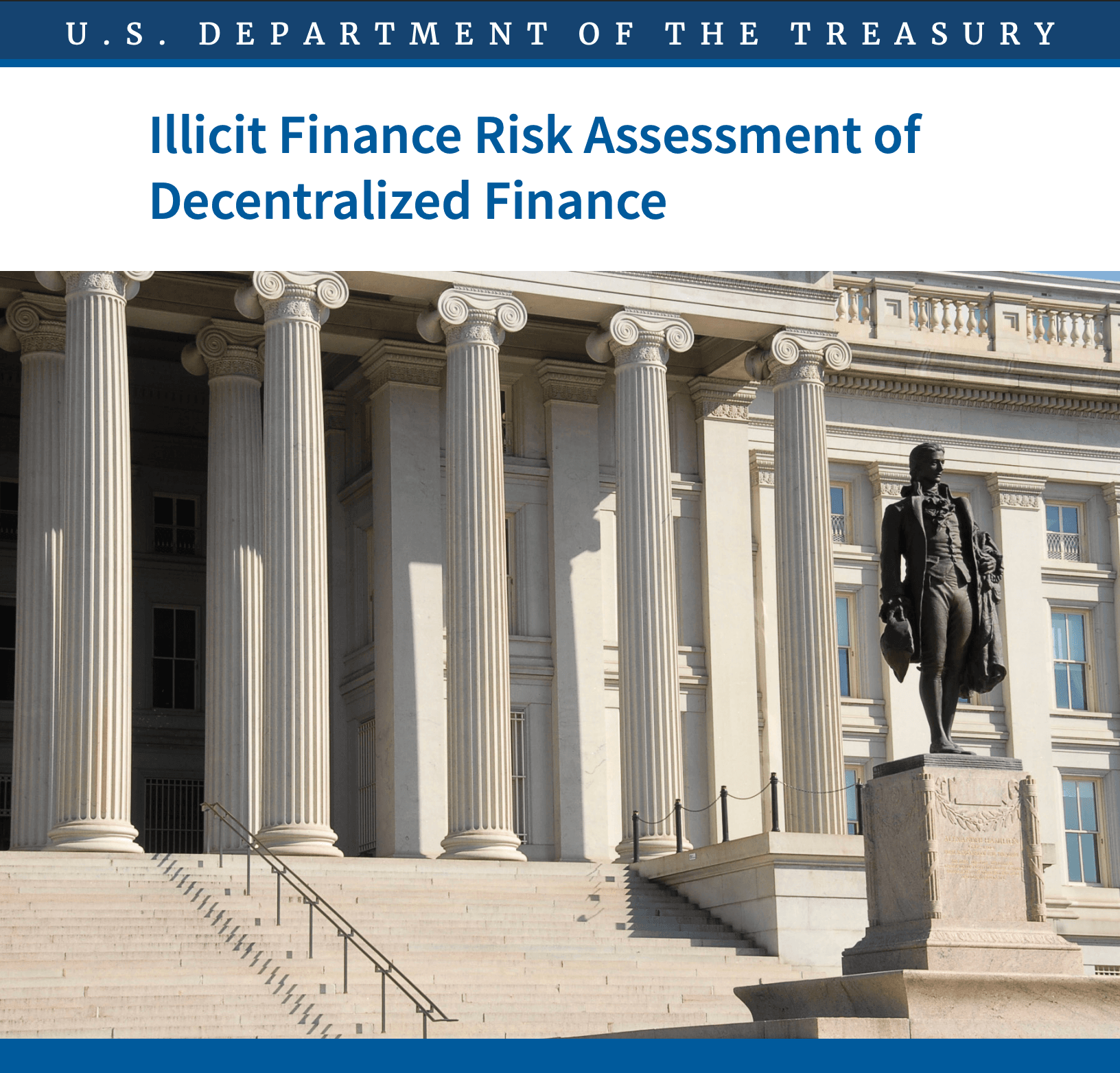
The U.S. Department of the Treasury's review on decentralized finance (DeFi) risks shows key concerns. It highlights that weak AML controls can let illicit activity seep into financial systems. This risk grows as DeFi adoption increases. For a detailed analysis, check the full DeFi Risk Review from the Treasury.
 Ignoring DeFi AML does not preserve decentralization. It often leads to indirect shutdowns or isolation from the broader ecosystem.
As DeFi merges with traditional finance, the tolerance for risk is shrinking. Protocols that ignore AML concerns risk losing liquidity, users, and institutional support.
The Shift Toward Risk-Based DeFi AML
To tackle these challenges, DeFi AML is shifting from identity checks to risk-based models.
This approach focuses on on-chain behavior rather than personal identity. Instead of asking who a user is, systems analyze:
-
Where funds originate
-
How they move across protocols and chains
-
What types of contracts and entities they interact with
Low-risk activity proceeds with minimal friction. Higher-risk flows trigger monitoring, restrictions, or reporting. This model fits decentralized architectures far better than traditional KYC.
Risk-based DeFi AML also aligns with regulatory guidance. Regulators increasingly emphasize proportional controls rather than blanket restrictions. Teams should find and manage risks as they arise, rather than stopping all activities.
This makes risk-based AML a practical bridge between compliance and decentralization.
Why Traditional Compliance Tools Do Not Fit DeFi
The philosophy of DeFi is unique, but the technology behind it is even more different. Many old compliance tools were made for the slow-paced world of fiat banking. In that system, transactions settle in days (T+2) and can often be reversed.
These tools fail in the Web3 environment for three critical reasons:
- The Speed Mismatch: Blockchain transactions are final. Once a bank manager confirms a block, they cannot "freeze" or reverse the funds. Traditional tools that depend on manual reviews or overnight batch processing are too slow. A legacy system may flag a suspicious DeFi trade too late. By then, the funds have probably moved through several bridges and protocols.
- Fragmented Data Silos: Traditional compliance software often works alone. It doesn't connect to the live blockchain. They can’t see how DeFi works like "Lego bricks." For example, a token can be swapped on Uniswap, wrapped, and then lent on Aave—all in one transaction.
- False Positives: Legacy rules are static (e.g., "flag all transactions over $10,000"). In DeFi, strict rules cause many false alarms. They stop real arbitrage traders and high-frequency bots. Meanwhile, they fail to catch the real money laundering schemes.
To work well, DeFi compliance needs blockchain-based tools. These tools should be automated and fast. They must read smart contract code and track funds across chains in milliseconds, not days.
Phalcon Compliance and a Blockchain-Native View of DeFi AML
Blockchain-native compliance platforms take a different approach. They analyze addresses, transactions, and fund flows directly on-chain.
Phalcon Compliance is built for blockchain regulatory compliance, not adapted from traditional finance. It focuses on behavior, exposure, and context rather than identity.
Key capabilities include:
- Real-time address and transaction analysis
Risk is assessed before execution, not after.
- Multi-hop fund tracing
Exposure is tracked beyond direct interactions.
- Cross-chain visibility
Risk follows funds as they move across ecosystems.
- Risk-based controls
Responses scale with severity instead of blocking all users.
This approach allows DeFi teams to meet AML expectations while preserving permissionless access. Compliance becomes a control layer, not a gatekeeper.
Applying DeFi AML Without Breaking User Experience
User friction remains one of the biggest concerns around DeFi KYC and DeFi AML. Heavy-handed controls drive users away. Weak controls increase regulatory exposure.
A tiered, behavior-based model offers a balance:
-
Most users experience fast, uninterrupted interactions
-
Medium-risk activity is monitored dynamically
-
High-risk flows receive targeted restrictions
This model protects protocols while preserving usability.
From a business perspective, this balance is critical. Users judge DeFi platforms not only by security but also by speed and reliability. Compliance systems must operate quietly in the background, not dominate the user experience.
DeFi AML in an Automated and AI-Driven Future
DeFi is moving toward automation. AI agents increasingly execute trades, manage liquidity, and route funds across protocols.
Traditional compliance models built around dashboards, accounts, and subscriptions do not work for autonomous agents. These agents need machine-readable, real-time compliance intelligence.
New delivery models combine Phalcon Compliance with agent-native access methods like X402. This allows compliance checks to happen directly inside execution flows.
In this future, DeFi AML becomes part of automated decision-making. Risk is evaluated instantly, and actions adapt in real time. Compliance no longer slows systems down. It guides them safely.
Conclusion: DeFi KYC Is Evolving, Not Disappearing
The future of DeFi KYC and DeFi AML isn’t only about choosing compliance or decentralization. It is about redefining compliance for blockchain systems.
Risk-based, on-chain, and real-time approaches offer a path forward. Platforms that grasp fund flows and behavior will grow more sustainably.
As regulators, users, and institutions converge on DeFi, blockchain-native compliance solutions like Phalcon Compliance show how DeFi AML can support innovation instead of blocking it.
Don't let compliance be a blocker—make it your competitive edge.
Frequently Asked Questions (FAQ)
1. Do I need to upload my ID (KYC) to use a DeFi wallet?
No, generally. Most DeFi wallets (like MetaMask or Phantom) are "self-custody." This means you control them, and you don't need to scan a passport to create one. However, some specific apps inside the wallet might ask for verification if they deal with real-world assets like stocks or bank transfers.
2. Can the IRS or government track my DeFi wallet?
Yes, they often can. Even though your name isn't on the wallet, the blockchain is a public list of every transaction. If you ever send money from a centralized exchange (like Coinbase) to your DeFi wallet, the government can link that wallet address to your real identity.
3. What happens if I interact with a "dirty" wallet by mistake?
This is a big risk. If you accidentally receive money from a hacker or a sanctioned wallet, your address might get "tainted." This could cause other safe apps to block you. This is why "Risk-Based AML" is important—it spots these bad connections before you interact with them.
4. What does "AML" actually look like in crypto?
Think of AML (Anti-Money Laundering) as a security filter. In traditional banking, a human checks your paperwork. In crypto, software scans the history of the money. It looks for red flags, like if the funds came from a known hack or a coin mixer, without needing to know your name.
5. Why does it feel like "Non-KYC" crypto is disappearing?
It feels that way because big institutions are entering the space. Big banks and investment firms want to use DeFi, but they are legally required to follow strict rules. As DeFi grows up and wants more global money, it has to adopt some safety rules, which makes total privacy harder to find.
6. How do crypto teams handle thousands of risk alerts?
In the past, they had to check them manually, which was impossible. Now, teams use AI and automated tools to filter the noise. These systems only flag the really dangerous stuff (like stolen funds) and let the normal, safe transactions go through instantly.
7. Is there a difference between a "DEX" and a centralized exchange regarding KYC?
Yes, there is a huge difference. A centralized exchange (CEX) is like a bank—they hold your money and require your ID. A Decentralized Exchange (DEX) is just code—you trade directly from your own wallet. Most DEXs do not require ID checks, but they do check wallet history for safety.
8. What are the "Red Flags" that get a wallet blocked?
The biggest red flags are interacting with "mixers" (tools used to hide money trails), receiving funds from known hacks, or dealing with wallets linked to sanctioned countries. If a wallet has a history of this behavior, compliance tools will flag it as "High Risk."
9. Will compliance ruin the speed of DeFi?
No, it shouldn't. Old compliance methods were slow because they involved humans. New "on-chain" compliance happens in milliseconds, powered by code. The goal is to stop the bad guys without slowing down the good guys.